
HomeKling 4.0 vs Kling 3.0
Comparison
Kling 4.0 vs Kling 3.0: Which AI Video Generator Is Better in 2026?
A hands-on Kling 4.0 vs 3.0 comparison using eight generated videos across four matched tests, with real results, winners, pricing, and upgrade advice.
On this page
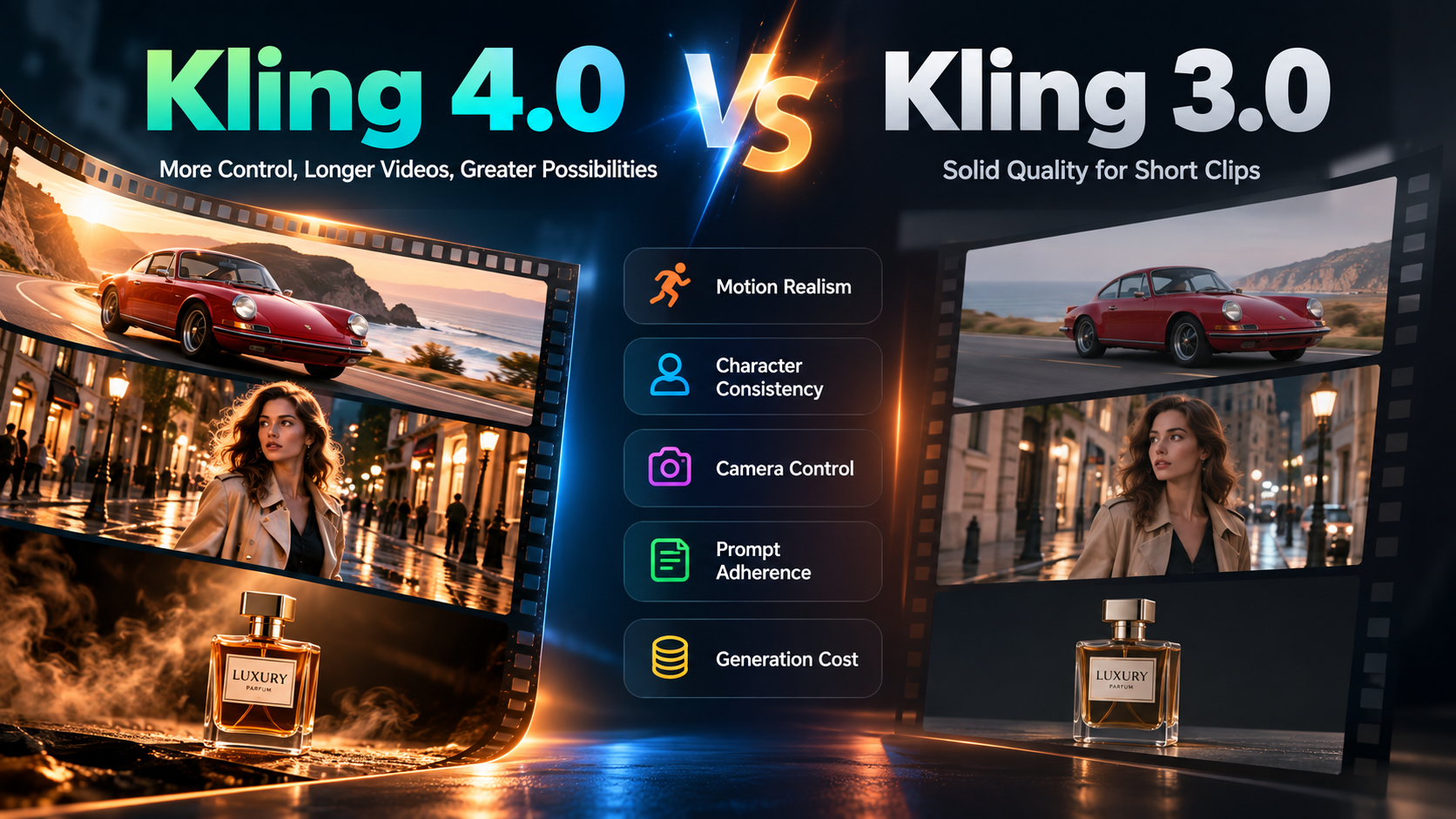
Kling 4.0 introduces new creative workflows and greater control over AI video generation. But does the newer model actually produce better videos than Kling 3.0?
To find out, we compared Kling 4.0 vs Kling 3.0 using eight generated videos across four matched tests. Both models received the same prompts for a coastal lighthouse, a ballet dancer, a mechanical wristwatch, and a pottery studio.
Rather than judging the models by promotional demonstrations, we examined their actual outputs for motion realism, character consistency, camera control, prompt adherence, and visual quality.
The results were not one-sided. Kling 4.0 showed advantages in camera movement and product presentation, while Kling 3.0 delivered a more energetic ballet performance. Both models also demonstrated limitations when handling detailed instructions.
In this comparison, we break down the real test results, explain the differences in available features, examine generation costs, and help you decide whether upgrading to Kling 4.0 is worthwhile.
Kling 4.0 vs Kling 3.0: Quick Verdict
Quick answer: Kling 4.0 is our overall winner in this four-test comparison, but Kling 3.0 remains competitive in human motion and short-form cinematic generation.
Kling 4.0 performed better in three of our four test scenarios, particularly where camera perspective and object consistency mattered. Kling 3.0 produced a more dynamic-looking ballet sequence, showing that the newer model does not automatically win every category.
Kling 4.0 vs Kling 3.0 Winner Table
| Category | Kling 4.0 | Kling 3.0 | Winner |
|---|---|---|---|
| Lighthouse | Strong aerial progression and stable architecture | More dramatic wave impact | Kling 4.0, slight edge |
| Ballet dancer | Controlled rotation and stable stage composition | More expressive movement and fabric motion | Kling 3.0, slight edge |
| Mechanical watch | More noticeable camera-angle changes | Attractive but mostly frontal presentation | Kling 4.0 |
| Pottery studio | More developed vase shape and varied compositions | Clear interaction but shorter, wider pottery | Kling 4.0, slight edge |
| Longer video workflow | Up to 30 seconds on Kling40AI | Depends on the available workflow | Kling 4.0 for the documented platform options |
| Reference and keyframe tools | Dedicated workflows on Kling40AI | Platform-dependent capabilities | Kling 4.0 for workflow flexibility |
| Audio quality | Not separately tested | Not separately tested | No winner |
| Pricing value | Depends on configuration and usable outputs | Depends on configuration and usable outputs | No verified winner |
Overall test result: Kling 4.0 leads 3–1 in our qualitative assessment.
This score represents four specific generated examples, not a statistically representative benchmark. Each model generated one output per scenario, and results may vary between attempts.
Our recommendation: Choose Kling 4.0 if camera direction, structured workflows, and product presentation are important. Consider Kling 3.0 if your priority is straightforward short-form generation and its output already meets your needs.
What Is the Difference Between Kling 4.0 and Kling 3.0?
Both models belong to the Kling AI video generation family, but they differ in the creative workflows available to users.
On Kling40AI, Kling 4.0 offers three primary modes:
- Text to Video: Generate footage directly from a written prompt.
- Reference: Use visual materials to guide a scene.
- Keyframes: Define important visual moments within a video sequence.
The Kling 4.0 interface also provides duration controls from 3 to 30 seconds, 720p and 1080p resolution options, and multiple aspect ratios.
Kling 3.0 remains capable of generating visually convincing footage, as our four comparison clips demonstrate. However, available controls depend on the platform and specific generation workflow.
For this article, we focus on a fair Text to Video comparison rather than assuming every feature difference translates directly into better visual quality.
How We Tested Kling 4.0 vs Kling 3.0
We selected four scenarios designed to challenge different aspects of AI video generation.
Both models received the same written prompt for each scenario.
| Test | Scene | Primary Challenge |
|---|---|---|
| Test 1 | Lighthouse and crashing waves | Environmental motion and camera stability |
| Test 2 | Ballet dancer performing a pirouette | Human anatomy and fabric movement |
| Test 3 | Mechanical wristwatch advertisement | Product consistency and camera orbit |
| Test 4 | Potter shaping a ceramic vase | Physical interaction and multi-shot instructions |
All eight submitted clips were approximately five seconds long.
The comparison focused on visible results rather than assigning artificial numerical scores.
We examined several points within each video, including the opening, middle, and ending compositions, and compared how the scene developed.
What We Evaluated
Motion realism: Whether moving subjects behaved naturally.
Subject consistency: Whether important objects, characters, and clothing remained recognizable.
Camera control: Whether the generated viewpoint followed the requested movement.
Prompt adherence: Whether the video included the specific actions described in the prompt.
Visual quality: Whether lighting, composition, and scene details remained convincing.
A visually attractive result was not automatically considered the winner. We also evaluated how closely each video followed the original instructions.
Test 1: Lighthouse — Environmental Motion and Camera Control
Test Objective
Our first test examined how Kling 4.0 and Kling 3.0 handle a coastal environment with moving waves, a stationary architectural subject, and an approaching aerial camera.
Water is a useful stress test because it involves continuous, irregular motion. At the same time, the lighthouse must maintain its structure as the viewpoint changes.
Test Prompt
A cinematic aerial shot of a white lighthouse standing on a rugged rocky coastline during golden hour. Powerful ocean waves crash against the dark rocks, sending white sea spray into the air. The camera slowly moves forward toward the lighthouse while maintaining a smooth, stable aerial perspective. Natural ocean physics, realistic foam movement, consistent lighthouse architecture, atmospheric sunlight, detailed coastal landscape, cinematic realism, 16:9.
Actual Video Output: Kling 4.0
Kling 4.0 generated a white lighthouse standing on dark coastal rocks, surrounded by moving water under warm evening light.
The lighthouse remained recognizable as the camera moved closer.
The composition developed from a relatively wider coastal view toward a more prominent lighthouse shot.
What worked well
The lighthouse maintained a stable overall shape, and the camera movement created a clear sense of progression.
The surrounding rocks and ocean remained visually coherent as the viewpoint changed.
Warm sunlight also helped establish a convincing coastal atmosphere.
Limitations
Although waves were visible throughout the clip, their motion was not consistently as dramatic as the prompt suggested.
The aerial movement was smooth but relatively restrained.
Actual Video Output: Kling 3.0
Kling 3.0 generated a similar coastal environment, with a white lighthouse, rocky shoreline, and powerful waves.
Its most noticeable feature was the dramatic wave impact.
Large bursts of sea spray rose around the rocks, making the environment feel energetic.
What worked well
The waves produced visually striking splashes, and the lighthouse remained stable.
The golden-hour lighting and rocky coastline also created an attractive cinematic composition.
Limitations
The camera movement was less pronounced than in the Kling 4.0 output.
Although the scene contained strong environmental motion, it did not communicate the requested forward aerial movement as clearly.
Test 1 Comparison
| Criterion | Kling 4.0 | Kling 3.0 |
|---|---|---|
| Lighthouse stability | Strong | Strong |
| Wave impact | Convincing | More dramatic |
| Camera progression | More noticeable | More limited |
| Coastal atmosphere | Strong | Strong |
| Overall prompt adherence | Slight advantage | Strong environmental interpretation |
Test 1 Winner: Kling 4.0 — Slight Edge
Kling 4.0 wins narrowly because its camera progression more closely matches the requested aerial movement.
Kling 3.0 deserves credit for producing stronger-looking wave impacts.
If the goal were purely dramatic ocean footage, the Kling 3.0 result could be preferable.
However, when considering the complete prompt, including the approaching camera, Kling 4.0 has a slight advantage.
Test 2: Ballet Dancer — Human Motion and Character Consistency
Test Objective
The second test focused on human movement.
A ballet pirouette is challenging because the model must coordinate the dancer's head, arms, torso, legs, and feet while keeping the dress and stage environment consistent.
Test Prompt
A professional ballet dancer wearing an elegant ivory dress performs a slow, graceful pirouette on a classical theater stage. The camera maintains a smooth medium-wide view as the dancer rotates. Her arms move naturally, her feet maintain believable contact with the stage, and the lightweight fabric flows with her movement. Preserve consistent facial features, natural anatomy, realistic hands and feet, stable clothing details, warm theatrical spotlighting, cinematic realism, 16:9.
Actual Video Output: Kling 4.0
Kling 4.0 generated a dancer wearing a light-colored dress on a theater stage with a dark curtain backdrop.
The dancer moved through several poses and completed a visible rotation.
What worked well
The stage remained consistent throughout the clip.
The dress retained its general appearance, and the camera maintained a controlled, medium-wide composition.
The dancer's overall body shape remained recognizable during the movement.
Limitations
Some portions of the motion appeared relatively restrained.
The transition between poses did not always convey the same fluidity as a continuous professional ballet performance.
The clip is visually coherent, but its movement is not especially expressive.
Actual Video Output: Kling 3.0
Kling 3.0 generated a dancer in an ivory-colored dress performing a more energetic rotation on a theater stage.
The fabric opened outward during the spin, creating a strong sense of motion.
What worked well
The dancer's movement appeared more dynamic.
The dress responded visibly to the rotation, and the stage composition remained attractive.
The extended arms and turning poses made the performance feel more expressive.
Limitations
The more energetic movement also makes precise anatomy and foot placement harder to judge.
Some details would benefit from frame-by-frame inspection at full resolution.
Neither short clip is sufficient to establish consistently accurate ballet technique.
Test 2 Comparison
| Criterion | Kling 4.0 | Kling 3.0 |
|---|---|---|
| Character continuity | Generally stable | Generally stable |
| Stage consistency | Strong | Strong |
| Rotation | Controlled | More dynamic |
| Fabric movement | Natural-looking | More expressive |
| Overall presentation | Restrained cinematic performance | More energetic dance performance |
Test 2 Winner: Kling 3.0 — Slight Edge
Kling 3.0 wins this test for its more expressive rotation and stronger visible fabric movement.
The result is particularly relevant for creators producing dance, performance, or fashion videos where movement is a major part of the visual appeal.
However, this does not prove that Kling 3.0 has universally better human anatomy or motion accuracy.
It performed better in this specific five-second example.
Test 3: Mechanical Watch — Product Consistency and Camera Control
Test Objective
Our third test examined product advertising.
A mechanical wristwatch is a demanding subject because it contains numerous small details, including the dial, hands, case, crown, and bracelet.
The prompt also requested a camera orbit, allowing us to evaluate whether the model could reveal different viewing angles while keeping the product coherent.
Test Prompt
A luxury stainless steel mechanical wristwatch with a black dial rests on a polished white marble pedestal inside a dark premium photography studio. The camera slowly orbits the watch, revealing the metallic case, polished bracelet, detailed dial, and reflective glass. Soft directional lighting creates elegant highlights across the steel surfaces. Preserve the watch's exact overall shape, dial layout, bracelet structure, and proportions throughout the video. Photorealistic luxury product advertising, cinematic studio lighting, 16:9.
Actual Video Output: Kling 4.0
Kling 4.0 generated a stainless steel wristwatch with a black dial on a light marble pedestal.
The video began with an angled product view and developed toward a more frontal composition.
What worked well
The changing perspective made the watch feel more three-dimensional.
The metal case, bracelet, and black dial remained recognizable throughout the short sequence.
The lighting created attractive reflections on the polished surfaces.
The output also resembled a premium product advertisement.
Limitations
The movement did not demonstrate a complete orbit around the watch.
Some fine dial details remained difficult to verify at the available viewing scale.
For commercial work involving a real watch model, a reference image and closer inspection would still be necessary.
Actual Video Output: Kling 3.0
Kling 3.0 generated a visually appealing watch advertisement with a black dial and metallic bracelet.
The watch was presented in a largely frontal composition.
What worked well
The product remained recognizable.
The dark studio background, metallic reflections, and marble pedestal created a premium visual style.
The overall composition was clean and suitable for a product showcase.
Limitations
The camera remained relatively static.
The output did not clearly deliver the requested orbit or reveal substantially different perspectives of the watch.
As a result, the video was closer to an animated product photograph than a dynamic camera-orbit advertisement.
Test 3 Comparison
| Criterion | Kling 4.0 | Kling 3.0 |
|---|---|---|
| Product appearance | Generally consistent | Generally consistent |
| Studio lighting | Strong | Strong |
| Camera movement | Noticeable perspective change | Mostly frontal |
| Three-dimensional presentation | Stronger | More limited |
| Prompt adherence | Better camera interpretation | Orbit largely absent |
Test 3 Winner: Kling 4.0
Kling 4.0 is the clearer winner in this test because it delivered more meaningful camera movement while maintaining a recognizable watch.
Both models produced attractive commercial-style visuals.
However, Kling 4.0 better communicated the intended three-dimensional product presentation.
This makes it the more promising result for the specific watch advertisement requested in our prompt.
Test 4: Pottery Studio — Physical Interaction and Multi-Shot Storytelling
Test Objective
The final test examined a more complex scene involving a person interacting with a changing object.
The potter's hands needed to shape wet clay on a rotating pottery wheel.
The prompt also requested three connected shots, creating an additional challenge involving camera transitions and scene continuity.
Test Prompt
A skilled potter shapes a ceramic vase on a spinning pottery wheel inside a warm, sunlit artisan studio. The video follows three connected cinematic shots: first, a medium shot of the potter working at the wheel; second, a close-up of both hands gently shaping the wet clay; third, a wider view revealing the finished vase taking shape. Preserve consistent hand anatomy, realistic clay deformation, smooth pottery wheel rotation, natural lighting, and continuity between shots. Photorealistic craftsmanship documentary style, 16:9.
Actual Video Output: Kling 4.0
Kling 4.0 generated a potter working at a spinning pottery wheel in a bright studio.
The sequence included a medium view of the potter, a close-up of the hands and clay, and a wider composition.
What worked well
The output showed recognizable hand-to-clay interaction.
The clay developed into a relatively tall, narrow vase-like form, closely matching the intended object.
The different camera compositions helped communicate the crafting process.
Natural window lighting created a convincing workshop atmosphere.
Limitations
The transitions between compositions were noticeable rather than perfectly continuous.
The clay's changing shape was not always shown through an uninterrupted physical transformation.
The video also did not fully establish a complete, continuous three-shot narrative.
Actual Video Output: Kling 3.0
Kling 3.0 generated a pottery scene featuring an artisan working with clay on a rotating wheel.
The video included close-up views of the hands and the developing ceramic object.
What worked well
The hand-to-clay interaction was visually clear.
The close-up composition made the crafting process easy to understand.
The workshop setting and natural materials created a convincing documentary-style atmosphere.
Limitations
The clay developed into a shorter, wider vessel rather than the taller vase suggested by the prompt.
The scene also changed camera composition without demonstrating fully continuous multi-shot storytelling.
As with Kling 4.0, precise physical deformation and hand anatomy require careful inspection.
Test 4 Comparison
| Criterion | Kling 4.0 | Kling 3.0 |
|---|---|---|
| Hand-to-clay interaction | Clear | Clear |
| Pottery shape | Taller vase-like form | Shorter, wider vessel |
| Shot variety | Multiple compositions | Multiple compositions |
| Studio atmosphere | Natural and bright | Natural and convincing |
| Multi-shot continuity | Partially achieved | Partially achieved |
| Prompt adherence | Slightly closer to requested vase | Strong interaction, less accurate final shape |
Test 4 Winner: Kling 4.0 — Slight Edge
Kling 4.0 wins narrowly because its resulting pottery shape more closely matches the requested vase, while also presenting several relevant camera compositions.
Kling 3.0 performed well in showing the hands working with clay.
Neither model fully demonstrated seamless multi-shot continuity, so this result should not be interpreted as proof that Kling 4.0 has mastered structured storytelling.
Overall Kling 4.0 vs Kling 3.0 Test Results
After reviewing all eight generated videos, Kling 4.0 holds the advantage in three of the four test scenarios.
| Test | Winner | Main Reason |
|---|---|---|
| Lighthouse | Kling 4.0 | Better alignment with requested aerial movement |
| Ballet Dancer | Kling 3.0 | More expressive rotation and fabric movement |
| Mechanical Watch | Kling 4.0 | Stronger perspective change and product presentation |
| Pottery Studio | Kling 4.0 | More accurate vase-like shape and useful shot variety |
What Kling 4.0 Did Better
Kling 4.0's most noticeable advantage was its interpretation of camera direction.
In the watch test, it changed perspective more clearly than Kling 3.0.
In the lighthouse test, it created a more noticeable approach toward the subject.
It also produced a taller vase-like object in the pottery scene, aligning more closely with the requested result.
These outcomes suggest potential benefits for creators who need more directed visual compositions.
What Kling 3.0 Did Better
Kling 3.0 remained competitive throughout the comparison.
Its lighthouse video featured more dramatic wave impacts.
Its ballet sequence was more energetic, with visible fabric movement that enhanced the sense of performance.
These results demonstrate that the newer model does not automatically produce the preferred output in every scene.
Where Both Models Struggled
Neither model consistently followed every detailed instruction.
The watch test requested an orbit, but neither output demonstrated a complete circular camera movement.
The pottery test requested three connected shots, but both videos contained noticeable changes in composition rather than perfectly continuous storytelling.
This highlights an important limitation of AI video generation: visual quality and prompt adherence are separate measures of performance.
A clip can look professional while still missing part of the requested action.
Kling 4.0 vs Kling 3.0: Video Quality
Both models produced visually appealing footage across our tests.
The lighthouse scenes featured attractive coastal lighting, the ballet scenes maintained recognizable theater environments, and the watch advertisements used convincing studio compositions.
Kling 4.0 showed a slight overall advantage in directing camera perspective.
Kling 3.0 remained capable of producing strong motion and cinematic atmosphere.
For creators, this means that choosing a model based solely on the model number is not enough.
The subject, prompt complexity, and intended visual result can all influence which output is more useful.
Kling 4.0 vs Kling 3.0: Character Consistency
Character consistency matters for fashion videos, advertisements, and storytelling.
In our ballet test, both models maintained recognizable dancers throughout the short clips.
However, a five-second rotation is not enough to establish how reliably either model preserves a character across multiple scenes.
The pottery test also involved human subjects, but the two models generated different artisans.
This is expected in independent text-to-video generations and should not be treated as an identity-matching failure.
For projects requiring a specific person or recurring character, reference-based testing would provide more meaningful evidence.
Verdict: Both models showed usable short-clip character continuity. Neither can be declared the overall character-consistency winner based on these tests alone.
Kling 4.0 vs Kling 3.0: Camera Control
Camera control produced one of the clearest differences in our comparison.
Kling 4.0 created more noticeable perspective changes in the lighthouse and watch tests.
Kling 3.0 often favored attractive but more restrained compositions.
However, neither model perfectly followed every camera instruction.
The mechanical watch test is particularly revealing: Kling 4.0 moved from an angled view toward a frontal composition, but this was not the complete orbit requested in the prompt.
Verdict: Kling 4.0 performed better in camera-direction adherence across these specific samples, although complex camera movements remain imperfect.
Kling 4.0 vs Kling 3.0: Audio Generation
Audio is increasingly relevant for AI-generated advertisements, social media videos, and narrative content.
Useful audiovisual capabilities can include environmental sounds, speech, and synchronization between visible actions and audio.
However, our four matched tests focused on visual generation.
We did not conduct a controlled comparison of dialogue, lip synchronization, or sound quality.
Verdict: No audio winner is assigned. A separate matched audio test would be required.
Kling 4.0 vs Kling 3.0 Pricing: Which Offers Better Value?
Pricing matters because AI video generation often involves experimentation.
A creator may need several attempts to obtain the desired movement, composition, or subject consistency.
On Kling40AI, Kling 4.0 uses a credit-based pricing system.
For one verified Text to Video configuration, a five-second 720p clip without a reference video costs 30 credits, equivalent to 6 credits per second.
| Setting | Kling 4.0 Tested Configuration |
|---|---|
| Mode | Text to Video |
| Resolution | 720p |
| Duration | 5 seconds |
| Reference video | None |
| Total cost | 30 credits |
This example does not establish the price of every Kling 4.0 generation or the equivalent Kling 3.0 configuration.
A fair pricing comparison should use current credit estimates for the same duration, resolution, and generation mode.
Cost per Usable Clip
The cheapest generation is not always the best value.
For example, if a product advertisement requires three attempts before the camera movement is acceptable, the effective cost is higher than the displayed price of one generation.
A useful formula is:
Cost per usable clip = Total credits spent ÷ Number of usable outputs
For professional work, this metric may be more useful than comparing credit rates alone.
Our tests show why: both models produced attractive videos, but some outputs would require another attempt if precise camera movement or scene continuity were essential.
Pricing verdict: Kling 4.0's demonstrated quality advantages may justify its use for some projects, but there is insufficient matched pricing evidence here to declare it the cheaper or better-value model overall.
Which Model Should You Choose?
Choose Kling 4.0 for Camera-Driven Product Content
Kling 4.0 is the stronger choice in our watch test.
Its perspective changes created a more dynamic product presentation, making it promising for product concepts and short commercial visuals.
Its available Reference and Keyframes workflows also provide additional options for more structured projects.
Consider Kling 3.0 for Dynamic Short-Form Motion
Kling 3.0 produced the preferred ballet result in our comparison.
Its expressive movement and flowing dress created an engaging performance.
For creators focused on short scenes where visual energy matters more than detailed camera choreography, Kling 3.0 remains worth considering.
Choose Kling 4.0 for More Structured Workflows
On Kling40AI, Kling 4.0 offers Text to Video, Reference, and Keyframes modes, along with longer generation durations.
These tools may be useful for advertisements, visual transformations, and planned storytelling.
However, our four tests used Text to Video only. The practical accuracy of Reference and Keyframes modes was not evaluated in this comparison.
Is Kling 4.0 Worth Upgrading From Kling 3.0?
Kling 4.0 is worth considering if your projects require more control over camera perspective, longer generation durations, or structured creation workflows.
Our tests suggest that it can deliver more directed visual compositions in certain scenarios.
However, the advantage is not universal.
Kling 3.0 produced a more expressive ballet sequence and remained competitive in cinematic atmosphere and visual consistency.
If you already use Kling 3.0 for straightforward short clips and are satisfied with the results, upgrading may not be necessary for every project.
A practical approach is to compare both models on the specific type of video you produce most often.
For example, a product advertiser should prioritize camera movement and packaging consistency, while a dance-content creator may care more about human motion and fabric behavior.
The better model is the one that produces a usable result for your particular creative goal.
How to Get Better Results From Both Models
Regardless of which model you choose, prompt structure can affect the quality of the output.
A useful format is:
Subject + Environment + Main Action + Camera Movement + Consistency Requirements
Focus on One Primary Action
A five-second video has limited time to develop a scene.
Instead of requesting several unrelated movements, identify the most important action.
For example:
A red paper lantern sways gently in the evening breeze as the camera slowly moves closer. Preserve the lantern's shape and warm internal glow.
Describe Camera Movement Clearly
Use direct instructions such as "slow forward push," "fixed wide shot," or "gentle side tracking."
Avoid combining too many different camera movements in a short clip.
Specify What Must Stay Consistent
For products, identify the details that matter.
For characters, specify clothing, hairstyle, and body proportions.
These instructions do not guarantee perfect consistency, but they make the intended result clearer.
Use References When Exact Appearance Matters
Text-to-video generation can produce convincing generic subjects.
However, it is not a reliable way to reproduce a specific commercial product or person exactly.
When supported, reference-based workflows can provide more direct visual guidance.
Review the Entire Video
Check the opening, middle, and ending frames.
A video may look excellent at first but contain inconsistent motion or missing actions later.
Our watch and pottery tests illustrate why reviewing the complete sequence is essential.
Frequently Asked Questions
Is Kling 4.0 better than Kling 3.0?
Kling 4.0 performed better in three of our four matched test scenarios, while Kling 3.0 won the ballet test. The result favors Kling 4.0 in this small sample, but it does not establish universal superiority.
What is the biggest difference between Kling 4.0 and Kling 3.0?
Kling 4.0 offers a broader creation workflow on Kling40AI, including Text to Video, Reference, and Keyframes modes. Our tests also showed stronger camera-direction adherence in some Kling 4.0 outputs.
Which model has better video quality?
Both produced attractive cinematic footage. Kling 4.0 had an overall advantage in our four tests, particularly in camera perspective and product presentation, while Kling 3.0 produced more expressive ballet motion.
Which model is better for human motion?
Kling 3.0 produced the preferred ballet sequence in our test, with more dynamic rotation and fabric movement. This does not prove it is better for every type of human motion.
Is Kling 4.0 better for product advertising?
In our mechanical watch test, Kling 4.0 generated more noticeable camera movement while maintaining a recognizable product. It was the preferred output for that particular advertisement.
Does Kling 4.0 support longer videos?
Kling40AI provides Kling 4.0 duration controls from 3 to 30 seconds. Available duration limits for Kling 3.0 depend on the platform and workflow.
Does Kling 4.0 support reference images and keyframes?
Yes. Kling40AI offers dedicated Reference and Keyframes modes. These workflows were not independently evaluated in our four Text to Video tests.
Is Kling 4.0 more expensive than Kling 3.0?
Costs depend on the platform and selected configuration. The verified Kling 4.0 example in this article costs 30 credits for five seconds at 720p without a reference video. A matched Kling 3.0 price is needed for a direct cost comparison.
Does Kling 4.0 follow prompts more accurately?
Kling 4.0 followed certain camera directions more closely in our tests. However, neither model completed every detailed instruction, particularly in the watch and pottery scenarios.
Is Kling 3.0 still worth using in 2026?
Yes. Our tests show that Kling 3.0 remains competitive, especially for short-form cinematic content and expressive human movement.
Final Verdict: Kling 4.0 vs Kling 3.0
After comparing eight generated videos across four matched scenarios, Kling 4.0 is our overall winner, taking three tests to Kling 3.0's one.
Kling 4.0 performed better in the lighthouse, mechanical watch, and pottery scenarios, primarily through stronger camera progression or closer alignment with the requested subject.
Kling 3.0 won the ballet test with a more energetic rotation and more expressive fabric movement.
Both models produced attractive cinematic visuals, and both occasionally simplified complex instructions.
The main lesson is that a newer AI video model does not automatically deliver the best result for every prompt.
Choose Kling 4.0 if you want more flexible creation workflows, stronger camera-direction performance in scenarios like those tested here, and additional options for longer or structured projects.
Consider Kling 3.0 if you mainly generate straightforward short clips and its motion style or generation cost better suits your needs.
For creators exploring the newer workflow, try Kling 4.0 on Kling40AI and evaluate the results using your own prompts.
The most useful AI video generator is not simply the newest one. It is the one that consistently produces footage you can actually use.